Organised by BioSol Centre · Course content and training by Foysal Ahammad
Hands-on professional training

Machine Learning & AI-Based Drug Design

From raw bioactivity data to docked, simulated and ML-rescored hits — a complete computer-aided drug discovery campaign you build with your own hands. Three tiers, from a first introduction to a supervised project that ends in a co-authored manuscript.

Open-source stack — no paid licences Hosted lab — nothing to install 300+ trained since 2019 Scholarships for Bangladeshi students
Tiers
Three
Basic · Advanced · Professional
Contact hours
30 – 60
Plus supervision on the top tier
Scholarships
Up to 70%+
Bangladeshi students, on request
Instalments
2 – 3
Available on every paid tier
Who runs this training

BioSol Centre — Biological Solution Centre

A biotechnology and bioinformatics research organisation in Bangladesh, founded in October 2019, putting the methods of modern pharmaceutical and genomic research into the hands of researchers who would otherwise have no route to them.

The Centre operates from Jashore, near Jashore University of Science and Technology, with an administrative address in Dhaka, and a team of 11–50 people including student researchers and trainees. It collaborates with academic researchers worldwide and with local organisations such as SeqBee Bioscience on joint workshops and computational drug design training.

Since 2019 the Centre has trained more than 300 students, researchers and teachers, co-authored over 20 peer-reviewed papers with trained participants in Q1, Web of Science and Scopus-indexed journals, and guided more than 30 participants into funded scholarships in the USA, Canada, Australia and beyond.

Two things happen here. We teach — three tiers of hands-on training in AI-based drug design, from a five-day introduction to a six-month supervised project. And we do the research — molecular docking, molecular dynamics, multi-omics, epigenomics and exome analysis, run for groups who need the result rather than the skill.

BioSol Centre
FoundedOctober 2019
Based inJashore & Dhaka, BD
Team11–50 people
Founder & CEOFoysal Ahammad
ReachOnline, worldwide
Track record since 2019
300+
Students, researchers and teachers trained
20+
Papers published with trained participants in Q1, Web of Science and Scopus-indexed journals
30+
Participants guided to funded scholarships in the USA, Canada, Australia and elsewhere
70%+
Scholarship available to Bangladeshi students, on request
Training summary

One curriculum, taught at three depths

Everything below is a selection from a single body of material. A participant who starts at the bottom and works up never repeats a session, and the fee they already paid is credited against the next tier. Cohort dates are announced at registration — see the registration page for the next intake.

Comparison of the three tiers
Tier 1 — BasicTier 2 — AdvancedTier 3 — Professional
PurposeLearn the toolsRun a full campaignPublish with supervision
Best forUndergraduates, MSc, PhD, postdocs — anyone starting outMSc, PhD, postdocs and faculty with their own targetResearchers at any level who need a publication
Length5 days · 30 hours4 weeks · 60 hours6 months · 60 h taught + supervision
Molecular dockingSingle targetValidated protocol, 1M libraryPublication-grade
MD simulationDemonstration only100 ns + full analysis3 × 200 ns + free energy
Machine learningQSAR, random forest+ GNN, ChemBERTa, ADMETBuilt for the manuscript
Generative designOverviewHands-onIf the project needs it
Manuscript support—Writing workshopDrafting to submission
OutcomeCertificate, 30 hComplete in-silico campaignCo-authored manuscript submitted

Full module-by-module coverage is on the Curriculum page. Prices, instalments and scholarships are on Fees & Scholarships.

How the training is built

One target carried through every stage

Most courses teach methods in isolation — a docking tutorial here, a machine-learning tutorial there. You leave able to run each tool and unable to assemble a campaign. Here a single target is chosen on day one and carried through every session, so each stage's output is the next stage's input.

Every stage feeds the next, and designs loop back through the models Six stages · docking, MD and machine learning on one target designs re-scored 1 · Target and data ChEMBL curation, splits Descriptors, fingerprints All tiers 2 · Predictive models QSAR, GNN, ChemBERTa Validation, applicability All tiers 3 · ADMET and filters Solubility, hERG, Ames Multi-task deep model Advanced + 4 · Structure and docking ESMFold / PDB, preparation Redock RMSD under 2 Å All tiers 5 · Screening and MD 1M library, staged funnel MD production, MM-PBSA Advanced + 6 · Design and write-up De novo, optimisation Figures, manuscript Professional

The workshop pipeline. The dashed loop is the design–make–test cycle: generated molecules go back through the predictive models and the validated docking protocol before anyone calls them candidates.

Choose your depth

Three tiers, one upgrade path

The fee you pay at a lower tier is credited in full against a higher tier taken within twelve months. Scholarships of more than 70 % are available to Bangladeshi students on request.

Tier 1

Basic

For anyone who wants working skills in docking and machine learning, without a project attached.

BDT 4,500Bangladesh rate

International USD 95 · Scholarships above 70 % for Bangladeshi students

Length5 days · 30 hours
CohortUp to 40
DeliveryLive online or on site
OutcomeCertificate, 30 h
  • RDKit, SMILES, descriptors and fingerprints
  • ChEMBL data extraction and curation
  • QSAR with random forest and XGBoost
  • Protein preparation and molecular docking
  • MD and generative design demonstrations
  • Annotated notebooks, 12 months of recordings
Tier 3

Professional

A supervised six-month research project ending in a manuscript submitted to a peer-reviewed journal.

BDT 55,000Bangladesh rate

International USD 1,100 · 3 instalments available

Length6 months + revisions
Cohort8 only
DeliveryWeekly 1:1 + group
OutcomeCo-authored manuscript
  • Everything in Advanced, run on a real project
  • 3 × 200 ns replica simulations with free-energy analysis
  • Weekly one-to-one supervision for six months
  • Literature review, methods design, results interpretation
  • Manuscript drafted by you, edited with your supervisor
  • Journal selection, submission and cover letter
  • Revision support to the first editorial decision
  • Public data and code deposit at submission
Cohort status

What is open right now

Cohorts run on a rolling basis rather than a fixed calendar, so a group starts once it fills. Register at any time — you are told the dates for your cohort when we reply, within two working days.

Tier 1 — BasicOpen · next group forming
Tier 2 — AdvancedOpen · entry task on application
Tier 3 — ProfessionalLimited · places capped, interview required
Private & departmentalOpen · scheduled to suit your group
Analysis services — docking, MD, multi-omics, exome, publication support — are taken on continuously, independent of cohorts. Register your interest
Who it is for

Every academic level, and industry too

There is no minimum degree. The entry requirement is basic Python, and the tier is matched to what you need rather than to your title.

Undergraduates

Final-year and project students in biotechnology, pharmacy, biochemistry or genetic engineering who want a real computational skill before they graduate.

Usually start at: Tier 1 — Basic

MSc & MPhil students

Thesis students who need docking, QSAR or MD results they can defend in a viva — and who would rather run them than wait on a collaborator.

Usually start at: Tier 1 or 2

PhD students & postdocs

Researchers with their own target who need a complete, validated campaign including molecular dynamics, and often a paper out of it.

Usually start at: Tier 2 or 3

Faculty & industry

Teachers adding computational content to a course, and scientists in discovery, DMPK or cheminformatics groups who need the current stack.

Usually start at: Tier 2, or a private cohort

Also a good fit

  • Wet-lab scientists who want to judge computational work rather than outsource it blindly
  • Bioinformaticians and data scientists moving into small-molecule discovery
  • Clinicians and public-health researchers working with genomic or omics data
  • Anyone preparing a scholarship or PhD application who needs a publication and a demonstrable skill

The only prerequisite

Basic Python — variables, loops, functions and pandas dataframes. No machine-learning background is assumed. A two-hour refresher notebook is sent before the course so you can check where you stand, and if you are not ready for a tier you are told before you pay, not after.

Scholarships

More than 70 % off for Bangladeshi students — on request

Cost should not decide who learns this. Any student resident in Bangladesh may apply for a scholarship of more than 70 % on any tier. There is no separate deadline and no application fee: write one short paragraph explaining your situation and what you want to do with the training, attach proof of enrolment, and send it to the course email.

What a scholarship covers

  • The full tier fee, reduced by the awarded percentage
  • All teaching, notebooks, recordings and certificates
  • Hosted compute for the duration of the course
  • The same supervision as every other participant

Scholarships are also open to international applicants in financial hardship, at a lower percentage. Article processing charges for the Professional tier are never covered — see the fees page.

Why train with BioSol Centre

Built for people who will use this on Monday

Honest validation, always

Every model is tested on a scaffold or time split, every docking protocol is validated by redocking before it is trusted, and every generative run is examined for reward hacking. You learn to produce numbers you can defend to a reviewer.

You type the code

Three and a half hours of guided coding every day. Demonstrations are kept to a minimum. Each notebook has a marked minimum path and optional extensions, so a mixed-ability group moves together.

Free and reproducible

RDKit, scikit-learn, PyTorch, GROMACS, AutoDock Vina and REINVENT. No licence blocks any exercise, and the whole environment rebuilds from one Docker image a year later.

Small cohorts, real support

One teaching assistant for every eight participants, and eight places only on the Professional tier. The cap is set by supervision time, not by seats, and it is not raised to meet demand.

Nothing to install

A hosted laboratory environment is provided for everyone. Log in, run every step in the browser, and keep the Docker image afterwards if you want to work locally.

Accessible by design

Scholarships above 70 % for Bangladeshi students, instalments on every paid tier, and separate rate cards so people are charged against the economy they actually live in.

Your instructor

Course content and training by Foysal Ahammad

All course material, laboratory design and supervision for this programme are developed and delivered by Foysal Ahammad, working in computational drug discovery — molecular docking, molecular dynamics simulation, machine learning for bioactivity and ADMET prediction, and structure-based design.

Teaching on this programme follows one rule: nothing is presented that the instructor has not run themselves on a real project, and no result is shown without the validation step that makes it believable.

He founded BioSol Centre in October 2019 and serves as its Chief Executive Officer. He is also a researcher at Hamad Bin Khalifa University (HBKU) in Qatar, working on a QNRF-funded project investigating paediatric cerebral palsy through whole-genome and epigenome sequencing. He holds an MSc in Biological Science from King Abdulaziz University and a BSc in Genetic Engineering and Biotechnology from Jashore University of Science and Technology.

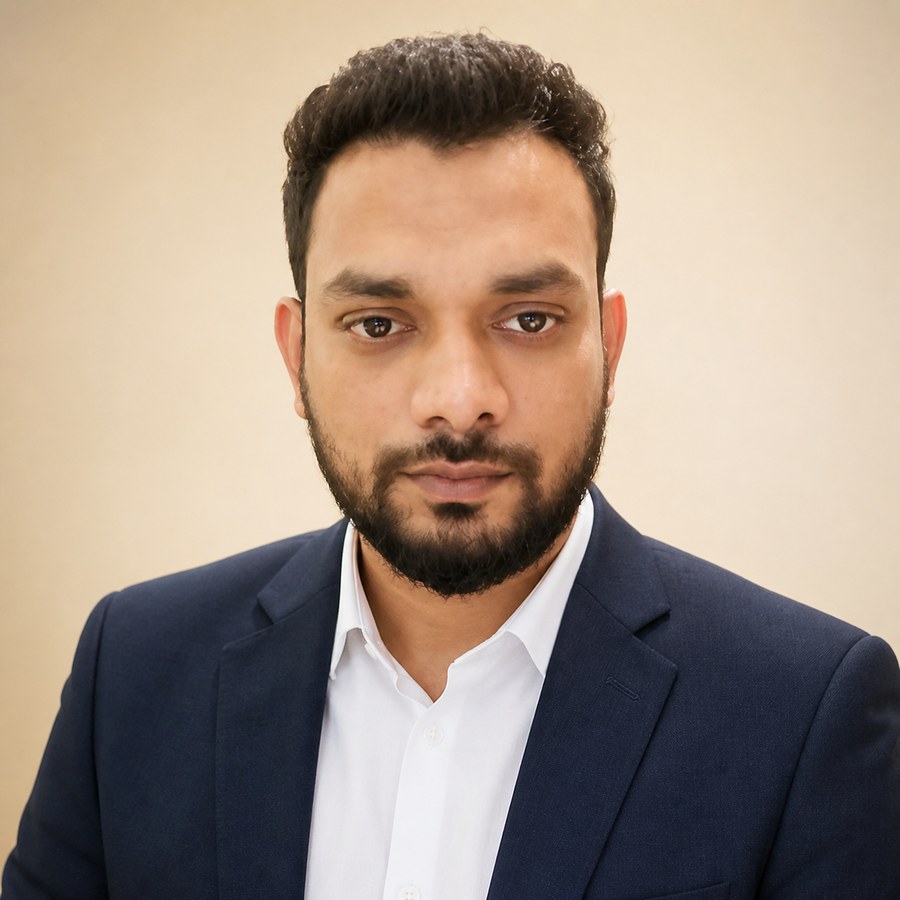
Foysal Ahammad, founder of BioSol Centre

Recent publications

  • 2026 — Machine learning modelling of perinatal risk profiles · BMC Med Inform Decis Mak
  • 2025 — EGFR-targeting phytochemicals in NSCLC · J Mol Struct
  • 2023 — SSBP3 ortholog and neurodevelopment · PLOS Biology
  • 2021 — Pharmacoinformatics screening of neem phytochemicals · Brief Bioinform

All publications →

Teaching focus

Molecular dockingMD simulationMM-PBSA QSARDeep learningADMET Virtual screeningGenerative designScientific writing
What you leave with

Artefacts, not just notes

  • Your own curated dataset, trained models and ranked hit list
  • A validated docking protocol with its redocking RMSD recorded
  • MD trajectories and binding free energies you generated yourself
  • The complete annotated notebook set, with solutions released daily
  • A Docker image and environment.yml that rebuild the stack in one command
  • Five one-page protocol sheets written as checklists for real projects
  • A reading list of the key papers behind every method taught
  • A verifiable certificate naming the modules and contact hours
24
Taught modules across the curriculum
35+
Open-source tools used hands-on
1 M
Compounds screened in the Advanced tier
600 ns
Total MD sampling on the Professional tier
An honest limit

No in-silico result replaces an assay. These methods reorder and prioritise chemical space; they do not confirm activity. Every participant finishes able to state this clearly to a collaborator — which is itself a learning outcome.

Beyond training

We also run the analysis for you

Not everyone needs to learn the method. BioSol Centre takes on computational and omics projects directly, with a free feasibility check before any quote.

Docking & virtual screening

Receptor preparation, validated docking protocols, million-compound screens, ML rescoring and consensus ranking.

Details →

MD simulation & free energy

System building, 100 ns to 1 µs production with replicas, full trajectory analysis, MM-PBSA and MM-GBSA.

Details →

Multi-omics analysis

Transcriptomics, single-cell, proteomics, metabolomics and integrated multi-layer analysis through to pathway enrichment.

Details →

Epigenomics

DNA methylation, ChIP-seq and ATAC-seq: differential methylation and peaks, annotation, motif discovery, browser tracks.

Details →

Exome & genome sequencing

GATK best-practice pipelines, germline and somatic variant calling, annotation, filtering and ACMG interpretation.

Details →

Publication support

Manuscript structuring, methods writing, figures, journal selection, cover letters and reviewer responses.

Details →

Ask a question, or apply for a place

Tell us your background and what you want to achieve, and you will get a straight answer about which tier fits — including whether you need this training at all.