Who runs this training, how it is taught, and the rules the publication track operates under.
BioSol Centre — Biological Solution Centre — is a biotechnology and bioinformatics research organisation in Bangladesh, founded in October 2019 by Foysal Ahammad. It exists to put the methods used in modern pharmaceutical and genomic research — molecular docking, molecular dynamics simulation, machine learning for bioactivity and ADMET, multi-omics and sequencing analysis — into the hands of researchers who would otherwise have no route to them.
The Centre operates from Jashore, near Jashore University of Science and Technology, with an administrative address in Dhaka, and a team of 11–50 people including student researchers and trainees. It collaborates with academic researchers worldwide and with local organisations such as SeqBee Bioscience on joint workshops and computational drug design training.
Training is delivered online, which keeps it reachable from anywhere and keeps the fees low. Participants in Bangladesh and participants abroad learn in the same cohorts, on the same material, with the same supervision — only the rate card differs, so that people are charged against the economy they actually live in rather than a single global price that excludes most of the world.
The second half of the work is research. The Professional tier is not a course with a certificate attached; it is supervised research that ends in a submitted manuscript, run under the integrity rules set out below. Participants do the work and earn the authorship, or they do not get it.
Those three numbers describe the same pipeline from different angles. People arrive to learn a method; a good proportion of them end up co-authoring the work they did during or after the training; and a further group use that publication and that skill to win funded places abroad. The scholarships we give out at the start are what make the other two numbers possible.
Three tiers of hands-on training in AI-based drug design, from a five-day introduction to a six-month supervised project.
Collaborative computational projects run to publication, with authorship determined by contribution.
Private training for departments and companies, on site or online, with the teaching target replaced by one of your own.
Multi-omics, epigenomics, exome sequencing, docking, MD simulation and publication support, run for researchers who need the result. See services →
More than 70 % off for Bangladeshi students on request, plus need-based waivers in every cohort.
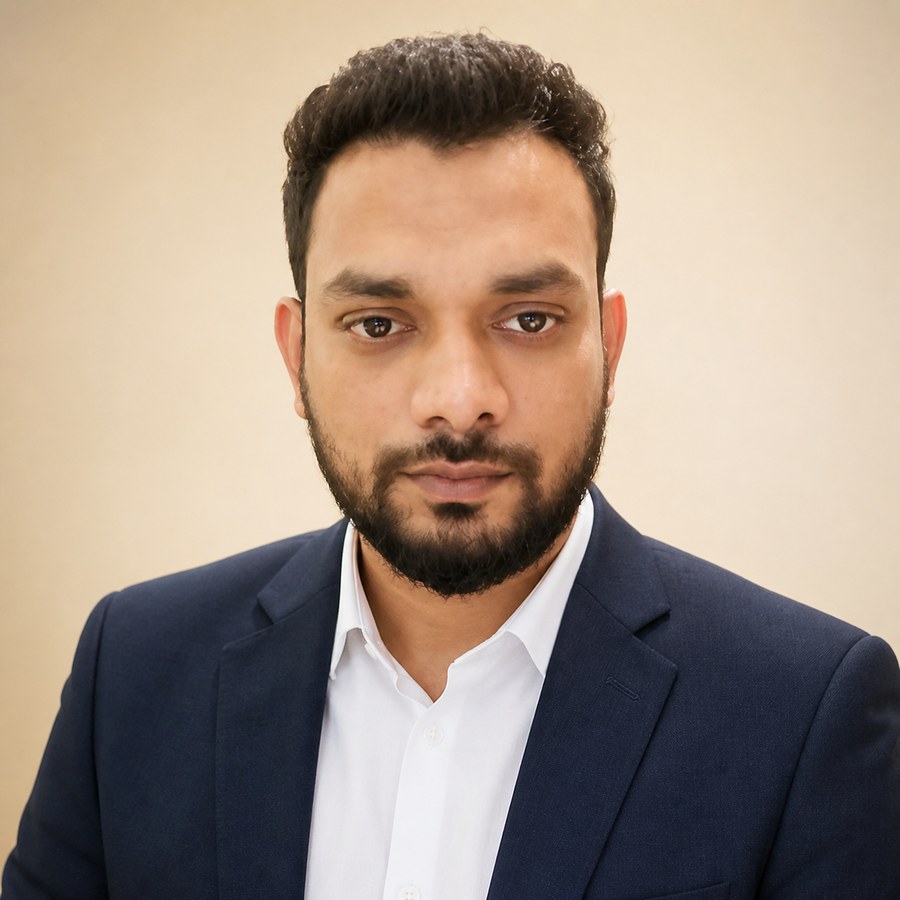
All course content, laboratory design and supervision for this programme are developed and delivered by Foysal Ahammad, working in computational drug discovery — molecular docking, molecular dynamics simulation, machine learning for bioactivity and ADMET prediction, structure-based design and virtual screening.
Foysal Ahammad founded BioSol Centre in October 2019 and serves as its Chief Executive Officer, leading its training programmes and research collaborations. He is a researcher at Hamad Bin Khalifa University (HBKU) in Qatar, where he works on a QNRF-funded project investigating paediatric cerebral palsy through whole-genome and epigenome sequencing.
His research spans neurobiology, microbiology, computational biology, machine learning, structural biology, genomics and AI/ML-driven drug discovery. Published work includes multi-epitope vaccine design against SARS-CoV-2, fish disease technology, and the identification of antiviral and anti-inflammatory compounds from mangrove and medicinal plants, appearing in Briefings in Bioinformatics, PLOS Biology, Scientific Reports, Frontiers in Chemistry, Journal of Molecular Structure and BMC Medical Informatics and Decision Making.
One rule governs the material: nothing is presented that the instructor has not run on a real project, and no result is shown without the validation step that makes it believable. Where a method fails — where a graph neural network loses to a random forest, where a redocking RMSD comes out above 2 Å — that failure is shown and explained rather than quietly replaced with a worked example that behaves.
A selected view of peer-reviewed work across drug discovery, computational biology, infectious disease, cancer and neurodevelopment. The methods taught in the training are the methods used in these papers.
Machine learning-driven modelling of synergistic perinatal risk profiles, connecting clinical evidence with interpretable prediction — an example of the translational AI and precision-medicine direction of the group's work.
BMC Medical Informatics and Decision Making · DOI: 10.1186/s12911-026-03710-y
The same five-stage shape — prepare, model, validate, interpret, report — underlies every pipeline taught in the training, whether the data is clinical, chemical or genomic.
Citation counts change constantly, so none are quoted here. The live Google Scholar record is the authoritative place to see current citations, h-index, co-authors and newly indexed work.
A single target is chosen at the start and used in every session, so each stage's output becomes the next stage's input and participants see where errors propagate instead of meeting each tool in isolation.
No docking protocol is used before redocking passes. No model is trusted before a scaffold split and a Y-randomisation test. Participants learn to produce numbers they can defend to a reviewer.
Demonstrations are kept to a minimum. Each notebook has a marked minimum path and optional extensions, so a cohort with mixed experience stays together without anyone being left behind or held back.
No in-silico result replaces an assay. These methods reorder and prioritise chemical space; they do not confirm activity. Every participant leaves able to say that plainly to a collaborator.
This policy governs the Professional tier. It is published in full because it protects participants as much as it protects the programme: a guaranteed publication cannot be delivered by anyone, and authorship exchanged for money is misconduct in the eyes of every journal. What the Professional tier sells is supervision. Authorship follows from the work, not from the invoice.
Each author must meet all four ICMJE conditions: a substantial contribution to the design or the analysis; drafting the work or revising it critically; approval of the final version; and agreement to be accountable for it. A participant who does not run their own analyses and does not write is acknowledged, not listed. This is explained at the admission interview and repeated in the written agreement.
Be careful. Services that promise acceptance, a named impact factor or authorship on a manuscript you did not work on are selling something that can be retracted later, with your name attached to the retraction. Ask any provider — including this one — to put their authorship criteria in writing before you pay.
Every fee, discount, instalment and refund rule is on this site. Nothing is quoted privately and no one is charged more because they asked later.
Eight places on the Professional tier, set by supervision time. The cap is not raised to meet demand, however good the demand looks.
If a cheaper tier would serve you better, or if you do not need the training at all, you are told so before you pay rather than after.
Every notebook is run end to end on a clean machine before a cohort starts. Anything that takes more than fifteen minutes is pre-computed and distributed.
Scholarships above 70 % for Bangladeshi students on request, need-based waivers in every cohort, and instalments without interest or credit checks.
You keep your data, your models and your code. On the Professional tier the analysis package is deposited publicly in your name at submission.
Ask anything — including the awkward questions about authorship, journals and what happens if a project does not work out.